Rotated interfacial Dzyaloshinskii–Moriya interaction
Last changes: Documentation changelog
Rotated interfacial DMI (rDMI) is the symmetry-specific interaction used by the Göbel et al. in-plane bimeron model. It is a separate physical term in Fullmag, not an alias for conventional interfacial DMI or bulk DMI.
Physical problem
A bimeron is a pair of merons embedded in an in-plane magnetized background. It
is topologically equivalent to a skyrmion after a global spin-space rotation, but
the stabilizing DMI operator must be rotated with the spin texture. The existing
fm.texture.bimeron preset only creates the initial magnetization; stability is
decided by the energy, effective field, boundary law, and time evolution.
Governing equations
For reduced magnetization \(\mathbf m=(m_x,m_y,m_z)^\mathsf T\), a constant signed coefficient \(D\), and magnetic domain \(\Omega_m\), Fullmag uses
This is \(D(L_{zx}^{x}+L_{xy}^{y})\). The sign of \(D\) selects the preferred chirality and is never replaced with its absolute value. With Fullmag’s \(\mathbf H_\mathrm{eff}=-(\mu_0M_s)^{-1}\delta E/\delta\mathbf m\) convention,
The FEM weak form uses the complete first variation,
Combined with exchange, an open magnetic surface with outward normal \(\mathbf n=(n_x,n_y,n_z)^\mathsf T\) obeys
Periodic faces do not receive the open-surface correction. A material-mask edge is an open magnetic surface; the non-magnetic airbox contributes neither rDMI field nor rDMI energy.
Symbols and SI units
Symbol |
Meaning |
SI unit |
|---|---|---|
\(E_{\mathrm{rDMI}}\) |
total rotated interfacial DMI energy |
\(\mathrm{J}\) |
\(D\) |
signed rotated interfacial DMI coefficient |
\(\mathrm{J\,m^{-2}}\) |
\(\Omega_m\) |
magnetic domain |
\(\mathrm{m^3}\) |
\(\mathbf m\) |
reduced magnetization |
\(1\) |
\(m_x,m_y,m_z\) |
Cartesian components of \(\mathbf m\) |
\(1\) |
\(\mathbf v\) |
admissible variation or FEM test field |
\(1\) |
\(\partial_i\) |
derivative with respect to coordinate \(i\) |
\(\mathrm{m^{-1}}\) |
\(\mathbf H_{\mathrm{rDMI}}\) |
interaction effective field |
\(\mathrm{A\,m^{-1}}\) |
\(\mu_0\) |
vacuum permeability |
\(\mathrm{N\,A^{-2}}\) |
\(M_s\) |
saturation magnetization |
\(\mathrm{A\,m^{-1}}\) |
\(A\) |
exchange stiffness |
\(\mathrm{J\,m^{-1}}\) |
\(\mathbf n\) |
outward magnetic-boundary normal |
\(1\) |
\(\partial_n\) |
derivative along \(\mathbf n\) |
\(\mathrm{m^{-1}}\) |
\(L_{ij}^{k}\) |
Lifshitz invariant \(m_i\partial_km_j-m_j\partial_km_i\) |
\(\mathrm{m^{-1}}\) |
\(\mathbf g_a\) |
assembled FEM energy derivative at node \(a\) |
\(\mathrm{J}\) |
\(M_a^{\mathrm{lump}}\) |
lumped nodal integration weight |
\(\mathrm{m^3}\) |
Assumptions and validity
The v1 public term accepts one spatially constant scalar \(D\) per problem.
The operator differentiates in \(x\) and \(y\), but film thickness remains part of the volume integral.
For nonzero \(D\), open boundaries require positive exchange stiffness so that exchange and rDMI use the coupled natural boundary law. This includes material-mask edges and the resolved local stiffness from material fields, not just an enabled
Exchangeterm. FDM and FEM treat \(D=0\) as a no-op and do not require exchange for this boundary law; the explicitly authored term remains in provenance.A finite \(D\) is required; positive, negative, and zero values are valid.
Spatially varying or tensor-valued DMI, atomistic frustration, temperature, and spin-orbit torque are separate models.
Python API and stage-first example
The public constructor is fm.RotatedInterfacialDMI(D=...). D is required,
has SI unit \(\mathrm{J\,m^{-2}}\), and must be finite.
Python parameter |
Type |
Default |
SI unit |
Validation |
Meaning |
Backend support |
ProblemIR mapping |
|---|---|---|---|---|---|---|---|
|
|
required |
\(\mathrm{J\,m^{-2}}\) |
finite; positive, negative, and zero values are accepted |
rDMI strength and chirality |
FDM/FEM CPU/GPU subject to lane-specific scientific qualification |
|
# %% Study and strict CUDA FDM lane
import fullmag as fm

study = fm.study("goebel_2019_bimeron_fdm")
study.engine("fdm")
study.device("gpu", precision="double")
study.mode("strict")
study.cell(0.5e-9, 0.5e-9, 0.5e-9)
study.pbc(x=True, demag="truncated_images")

# %% Thin film and implemented bimeron initial texture
film = study.geometry(
    fm.Box(size=(500e-9, 40e-9, 0.5e-9), name="film"),
    name="film",
)
film.Ms = 0.58e6
film.Aex = 15e-12
film.alpha = 0.3
film.Ku1 = 0.8e6
film.anisU = (1.0, 0.0, 0.0)
film.m = fm.texture.bimeron(
    radius=10e-9,
    wall_width=3e-9,
    vorticity=-1,
    helicity_rad=0.0,
    background_sign=1,
    plane="xy",
)

# %% Rotated DMI, relaxation, and zero-current hold
study.terms.add(fm.RotatedInterfacialDMI(D=3e-3))
study.demag(realization="auto")
study.solver(fix_dt=2.5e-15, integrator="rk45")
study.stages.add_relax(
    stage_id="relax",
    algorithm="llg_overdamped",
    solver="rk45",
    dt=2.5e-15,
    relax_alpha=0.3,
    max_steps=8_000,
    max_physical_time_s=20e-12,
    tolT=1e-6,
)
study.stages.add_run(stage_id="hold", until=100e-12)
ProblemIR
The constructor lowers without conversion to another DMI variant:
{
  "kind": "rotated_interfacial_dmi",
  "D": 0.003
}
The canonical Rust variant is EnergyTermIR::RotatedInterfacialDmi { d }.
Only one rotated-interfacial term may be authored in a problem.
Round-trip and failure semantics
Python authoring, UI authoring, script export, and reload preserve the interaction
kind and signed bit value of D. Requested solver/device/precision remain distinct
from resolved and executed runtime provenance. Non-finite coefficients, duplicate
terms, mixed conventional/rotated DMI (including object-scoped terms), invalid
periodicity, an unsatisfied exchange boundary requirement, or an unavailable
strict lane fail before execution. Fullmag never substitutes conventional
interfacial DMI, bulk DMI, or a CPU fallback.
In contract terms, requested intent is the authored interaction and execution request; resolved execution is the planner’s selected legal lane; validation errors reject malformed or contradictory data; and unsupported combinations fail closed before a backend starts.
The canonical quantities are H_rotated_dmi in \(\mathrm{A\,m^{-1}}\),
eden_rotated_dmi in \(\mathrm{J\,m^{-3}}\), and E_rotated_dmi in \(\mathrm{J}\).
Requesting them without an active rotated-interfacial term is rejected. The
current FEM path also rejects the two field quantities until their separate
materialization path exists; global E_rotated_dmi remains available.
E_dmi and eden_dmi include the rotated component; E_total and eden_total
count it only once. A completed-run manifest stores both aggregate
final_e_dmi and the separate final_e_rotated_dmi component. The API prefers
the separate component; for legacy manifests it uses final_e_dmi for
E_rotated_dmi only when the saved plan proves that rDMI is the sole DMI term.
FDM supports on-demand eden_rotated_dmi materialization,
but scheduled snapshots and field autosave of that scalar field are currently
rejected. FEM eigenmode and frequency-response profiles reject rDMI and do not
advertise its quantities.
Discrete realization and backend status
FDM CPU is the double-precision reference and uses centered interior differences with exchange+rDMI ghost values at open faces. FDM CUDA implements the same field, energy, and boundary correction in FP64 and FP32. FEM assembles the complete weak residual and projects the field using
FEM GPU uses the same element residual in device kernels. Nonzero static-periodic FEM rDMI is rejected until residual and mass reduction over periodic node classes is implemented; the periodic Göbel qualification therefore uses FDM. Source implementation or a successful build is not scientific runtime qualification.
The FDM planner validates resolved cellwise exchange stiffness, but native CUDA still rejects cellwise material fields. This validation does not add native CUDA support for spatially varying exchange coefficients.
Solver |
Device |
Implementation status |
Scientific runtime status |
|---|---|---|---|
FDM |
CPU |
implemented and operator-tested |
Göbel bimeron run not verified |
FDM |
GPU |
FP64/FP32 implemented and operator-tested |
historical 15-check report; current 19-check run not verified |
FEM |
CPU |
MFEM weak form implemented and tested |
Göbel bimeron run not verified |
FEM |
GPU |
CUDA residual implemented; historical operator tests |
current cancellation-bound CUDA regression and Göbel bimeron run not verified |
Implementation mapping
The semantic path is Python DSL -> ProblemIR -> validator -> planner -> runner/ABI -> backend -> quantities/artifacts. Equations, signs, units, quantity IDs, and
validation criteria are shared; FDM/FEM and CPU/GPU keep separate numerical owners.
Göbel 2019 validation
The reference case is a \(500\times40\times0.5\,\mathrm{nm^3}\) film with one \(0.5\,\mathrm{nm}\) FDM cell through thickness, periodic \(x\), \(M_s=0.58\, \mathrm{MA\,m^{-1}}\), \(A=15\,\mathrm{pJ\,m^{-1}}\), \(D=3\, \mathrm{mJ\,m^{-2}}\), \(K_x=0.8\,\mathrm{MJ\,m^{-3}}\), and \(\alpha=0.3\).
The stored strict FP64 CUDA report was generated before the verifier gained its current 19 checks. It previously passed 15/15 checks after 20 ps relaxation and a 100 ps zero-current hold, but that historical report is NOT VERIFIED against the current verifier until the run is repeated. The historical result reported topological charge changing from \(-0.9996834\) initially to \(-0.9999895\) after the hold; the two opposite-sign \(m_z\) cores remained resolved, the background reached \(\langle m_x\rangle=0.9858318\), and total energy decreased from \(-7.7736\times10^{-18}\,\mathrm J\) to \(-8.1467871\times10^{-18}\,\mathrm J\). Its device receipt reported the required CUDA operator mask 159/159 and no host, unknown, or fallback execution; those values do not replace a fresh 19-check verification.
The current verifier requires at least 20 ps of relaxation and 100 ps of
zero-current hold, measured from the saved state times. The figure generator
uses those actual times for its panel labels and stage durations. Its Pillow
dependency is declared in the Python figures extra and in just ensure-python.
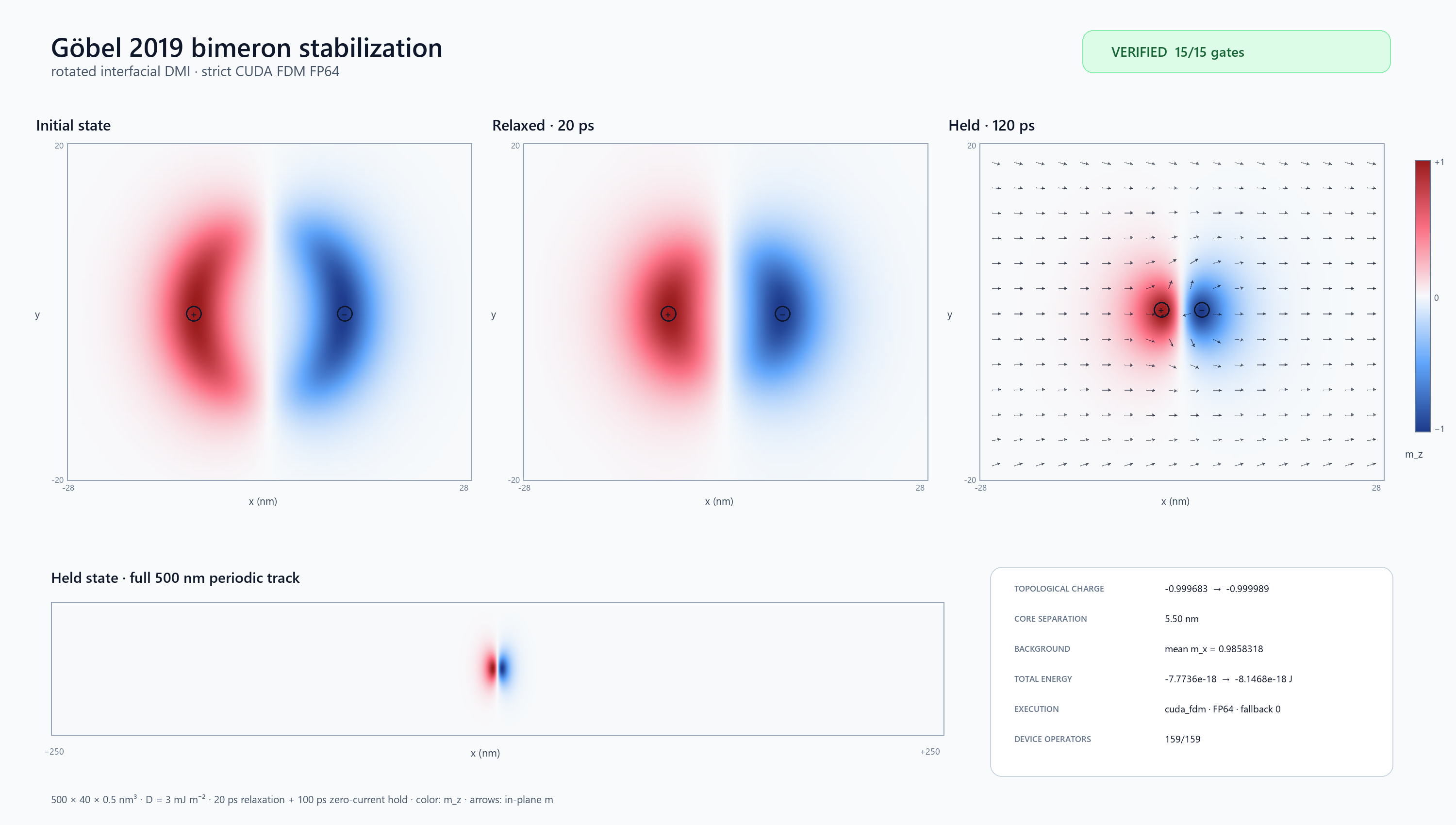
Historical FDM CUDA FP64 stabilization artifact. Color encodes \(m_z\); arrows in
the held-state close-up show the in-plane magnetization. The figure is
generated from the stored scenario bundle and its fail-closed verification
report by scripts/render_goebel_2019_bimeron_figure.py; current 19-check
qualification remains NOT VERIFIED until a fresh run.
See DMI validation for the cross-variant DMI validation matrix. A fresh 19-check report is required before this artifact can qualify the stated FDM CUDA FP64 case; FDM CPU and both FEM bimeron runtimes remain not verified.
Limitations
Spatially varying \(D\), a general \(3\times3\) DMI tensor, FEM orders above P1, atomistic frustrated exchange, and Göbel’s current-driven SOT motion are not qualified by this result. A stabilized initial state is not evidence for the velocity results in Fig. 3 of the paper.
Scientific bibliography
B. Göbel, A. Mook, J. Henk, I. Mertig, and O. A. Tretiakov, “Magnetic bimerons as skyrmion analogues in in-plane magnets,” Physical Review B 99, 060407(R) (2019), doi:10.1103/PhysRevB.99.060407.
Source-code index
Contract |
Repository path |
Stable symbol |
Responsibility |
|---|---|---|---|
Python API |
|
|
validation and ProblemIR lowering |
ProblemIR |
|
|
distinct serialized interaction variant |
ProblemIR validation |
|
|
finite-value and duplicate-term validation |
FDM planning |
|
|
legality, boundary, and runtime selection |
FEM planning |
|
|
legality and backend plan |
Scalar artifacts |
|
|
plan-guarded completed-run energy fallback |
Modal capabilities |
|
|
reject unsupported rDMI modal quantities |
FDM CPU |
|
|
reference field and energy |
FDM CPU energy |
|
|
reference interaction energy |
FDM CUDA |
|
|
FP64 field and boundary correction |
FDM CUDA boundary |
|
|
rotated exchange+DMI ghost correction |
FEM weak residual |
|
|
first variation shared by FEM realizations |
FEM plan import |
|
|
import the rotated coefficient from the extended ABI into the MFEM context |
FEM CUDA |
|
|
device element residual |
Göbel scenario |
|
|
canonical public reproduction |
Göbel verifier |
|
|
topology, energy, and execution receipt gates |