FullMag
Last changes: Documentation changelog

Finite-difference and finite-element micromagnetics
EU Horizon Europe · MSCA
Funded by the European Union under HORIZON-MSCA-2024-PF-01, Grant Agreement No. 101208951 (CNMA).
Documentation organized by ownership
Frontend, backend, and Python API are separate documentation families.
The documentation tree follows the layer that owns a fact. Control Room behavior is documented under Frontend; numerical realization, physics, and runtime contracts under Backend; public authoring commands and parameters under Python API. Install the pure-Python DSL from PyPI (pip install fullmag) and run solves inside the Docker Compose DEV runtime.
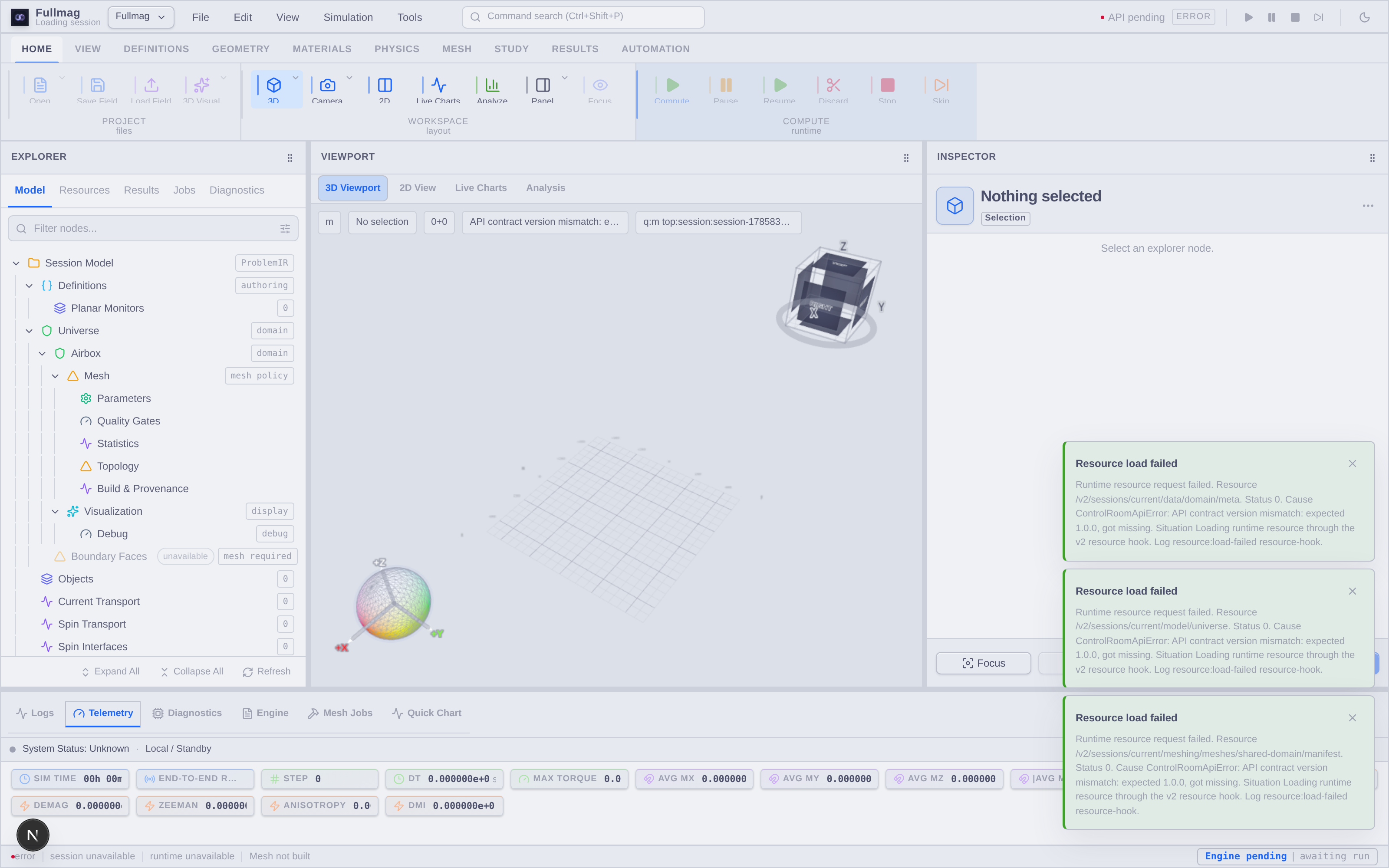
The FullMag Control Room unified workspace for authoring FDM and FEM models, monitoring live Python sessions, visualizing 2D/3D vector fields, and analyzing spectral and time-domain results.
How to use this documentation
Question |
Canonical branch |
|---|---|
How do I operate the browser application? |
|
What algorithm and data structure does the solver execute? |
|
Which Python command or parameter should I use? |
|
How was a capability validated? |
|
How do I run a first study? |
|
Where are EU grant details, institutional credits, and inspired-solver citations? |
The same concept may appear in more than one branch, but each page has one owner. For example, FEM meshing is split into:
Frontend: panels, drafts, Apply/Build transactions, reports, and visualization;
Backend: Gmsh/MFEM realization, topology, conformity, fallbacks, and numerical validity;
Python API:
FEM,PerObjectMeshRecipe,study.universe.mesh(...), object mesh helpers, parameter tables, and ProblemIR lowering.
Simulation data flow
Python API or Control Room
            │
            ▼
      canonical ProblemIR
            │
            ▼
 planner and capability resolution
            │
            ▼
 backend mesh / operators / stages
            │
            ▼
 artifacts, diagnostics, provenance
Requested intent and resolved execution are never treated as the same object. A mesh parameter entered in Python or the UI is a request; the generated mesh, its topology, quality, markers, fallbacks, and digest are backend evidence.
Funding & European Union grant acknowledgement
Horizon Europe · MSCA Postdoctoral Fellowship
Mateusz Zelent acknowledges funding from the European Union's Horizon Europe programme under HORIZON-MSCA-2024-PF-01, Marie Skłodowska-Curie Grant Agreement No. 101208951 (CNMA).
Funded by the European Union. Views and opinions expressed are however those of the author(s) only and do not necessarily reflect those of the European Union or the European Research Executive Agency (REA). Neither the European Union nor the granting authority can be held responsible for them.
Scientific heritage & ecosystem
FullMag’s workflow, numerical abstractions, and benchmark suite draw inspiration from pioneering open-source micromagnetic packages — including MuMax3, Amumax, mumax⁺, Boris Computational Spintronics, OOMMF, TetraX, Tetmag, and NeuralMag — as well as core scientific libraries such as MFEM, Gmsh, hypre, libCEED, and PETSc/SLEPc. See Acknowledgements for full attributions, software descriptions, and literature citations with DOIs.
Citation
Until a versioned release with a persistent identifier is available, cite the repository and the
exact commit used for the reported result (alongside the published fullmag PyPI version when applicable); full BibTeX and related software references are collected on Acknowledgements.
Bibliography
No independent scientific model is introduced by this navigation page. Use the bibliography on Acknowledgements or the selected terminal page; this statement is an explicit applicability boundary, not an omitted reference.
Source-code index
This is a navigation page and introduces no standalone implementation symbol. The exact source-code index is maintained by the selected terminal page.