Spin Hall drift-diffusion transport
Last changes: Documentation changelog
Fullmag treats the spin Hall effect (SHE) as a solved charge-and-spin transport problem, not an algebraic torque coefficient. A charge solution drives vector spin accumulation, a rank-two spin-current tensor transports angular momentum, and a named torque consumer transfers absorbed transverse spin to magnetization.
This terminal page keeps the physics, public API, capability envelope, and source evidence in one auditable contract because the scientific-doc validator requires every scientific page to carry the complete model, API, and backend-lane contract. Jump to equations, interfaces, Python, numerics, or validation.
Physical problem
A heavy metal (HM) carries conventional charge current. Spin-orbit scattering generates transverse spin current and spin accumulation \(\boldsymbol\mu_s\). At an oriented HM/FM interface, longitudinal spin is transmitted or reflected while absorbed transverse spin torques the ferromagnet (FM).
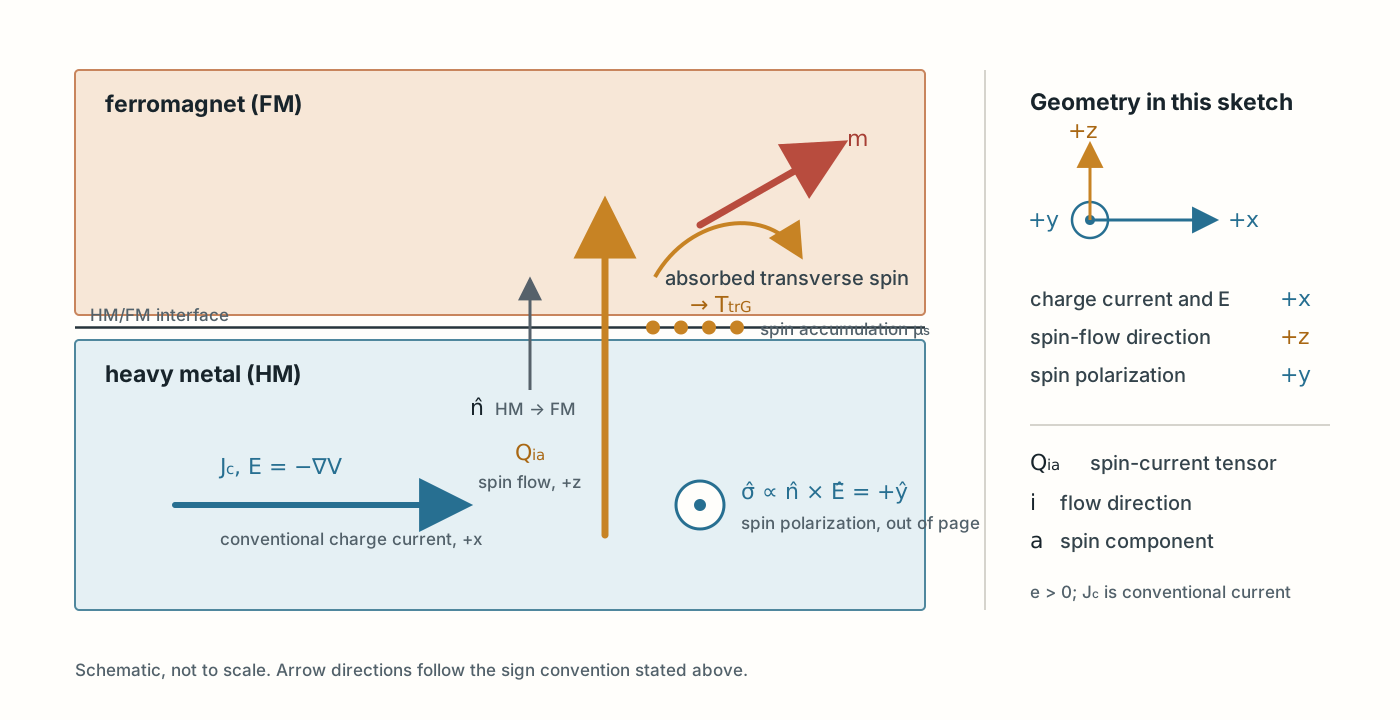
Fullmag convention map. The first index of \(Q_{ia}\) is flow direction and the second is spin polarization. Here the normal points from HM to FM.
Fullmag uses \(e>0\), conventional current, and \(\mathbf E=-\nabla V\). Here \(\sigma\) is charge conductivity, distinct from spin conductivity \(\sigma_s\). The direct-SHE contribution is proportional to \(\theta_{\mathrm{SH}}\sigma(\mathbf n\times\mathbf E)\). Reversing \(\theta_{\mathrm{SH}}\), current, \(\mathbf n\), or HM/FM orientation reverses the corresponding polarization or flux. A material sign is meaningful only with these definitions.
Governing equations
\(\boldsymbol\mu_s\) is the full spin-channel voltage splitting: the channels are \(V+\boldsymbol\mu_s/2\) and \(V-\boldsymbol\mu_s/2\). \(Q_{ia}\) is charge-equivalent spin current; \((\hbar/2e)Q_{ia}\) is angular-momentum current.
M1 one-way FDM face flux
Here \(\sigma_f\) is accepted face charge conductivity and \(\sigma_{s,L/R}\) are spin conductivities.
fv_spin_upwind_v1 chooses \(\mathbf m_{\mathrm{up}}\) from the sign of \(P_fJ_{c,i}\);
the central reference operator averages neighbors. The steady balance is
Only exchange rotation and dephasing torque the FM:
Absorbed transverse interface flux uses the same negative convention after area-to-volume conversion.
M2 reciprocal FDM block
The current FDM implementation uses \(\sigma_s\) in reciprocal polarization and SHE blocks. Older target-contract prose using scalar charge \(\sigma\) in these terms is not the implemented FDM law:
M2 solves \((V,\mu_{s,x},\mu_{s,y},\mu_{s,z})\) per cell. The last charge term is inverse SHE; the symmetric anisotropic term contains AMR/PHE and the cross product contains AHE.
Symbols and SI units
Symbol |
Meaning |
SI unit |
|---|---|---|
\(V\) |
charge electrochemical potential |
\(\mathrm{V}\) |
\(\boldsymbol\mu_s\) |
full spin-channel splitting |
\(\mathrm{V}\) |
\(E_i\) |
electric field |
\(\mathrm{V\,m^{-1}}\) (V/m) |
\(G_{ia}\) |
negative half-gradient of spin voltage |
\(\mathrm{V\,m^{-1}}\) (V/m) |
\(J_{c,i}\) |
conventional charge-current density |
\(\mathrm{A\,m^{-2}}\) (A/m^2) |
\(Q_{ia}\) |
charge-equivalent spin-current tensor; flow index first |
\(\mathrm{A\,m^{-2}}\) (A/m^2) |
\(\sigma_s\) |
spin conductivity and implemented M2 reciprocal coefficient |
\(\mathrm{S\,m^{-1}}\) (S/m) |
\(P\) |
signed transport polarization |
\(1\) |
\(\theta_{\mathrm{SH}}\) |
signed spin Hall angle in the Fullmag convention |
\(1\) |
\(\lambda_{\mathrm{sf}},\lambda_J,\lambda_\phi\) |
active reaction lengths |
\(\mathrm{m}\) |
\(\mathbf R_{\mathrm{sf}},\mathbf R_J,\mathbf R_\phi\) |
reaction densities |
\(\mathrm{A\,m^{-3}}\) (A/m^3) |
\(G_\uparrow,G_\downarrow,G_r,G_i\) |
interface conductances per area |
\(\mathrm{S\,m^{-2}}\) (S/m^2) |
\(M_s\) |
saturation magnetization |
\(\mathrm{A\,m^{-1}}\) (A/m) |
\(\mathbf T_{\mathrm{tr},G}\) |
Gilbert-form transport torque source |
\(\mathrm{s^{-1}}\) (1/s) |
Boundaries and interfaces
Authoring includes SpinInsulating, SpinSink,
SpecifiedSpinPotential, outward SpecifiedSpinFlux, and
PeriodicSpin. A negative-axis face reverses outward flux when stored in positive-axis
form. Transparent interfaces enforce continuity. With \(\Delta V=V_N-V_F\) and
\(\Delta\boldsymbol\mu_s=\boldsymbol\mu_{s,N}-\boldsymbol\mu_{s,F}\), M1 longitudinal
injection/backflow is
The \(G_r,G_i\) transverse absorption law is
For magnetic cell \(K\) adjacent to face \(f\), the interface torque contribution is
Optional spin-memory-loss reservoir data exists in authoring/reference FDM but is not generally executable. The spin domain must be a subset of the conducting charge domain; material coverage must be complete and non-overlapping.
M1, M2, and prescribed SOT
Model |
Charge path |
Spin/torque path |
|---|---|---|
M1 |
solved first; no spin-to-charge feedback |
direct SHE, diffusion, reactions, absorbed-spin torque |
M2 |
coupled AMR/PHE/AHE, polarization, and iSHE |
reciprocal block and named-solve torque |
Prescribed SOT |
no drift-diffusion solve |
authored drive, efficiencies, and FM thickness |
Canonical fm.DriftDiffusionSpinTorque(id, solve_id, target) consumes a named solve.
The same-named class in fullmag.model.spin_torque is a hidden legacy semantic
placeholder; its current-density signature is not the public API.
Assumptions and validity
The model is diffusive and continuum-scale. Active conductivities and lengths are positive; absent
reactions use None. A realistic HM/FM model needs separate regions, oriented interface,
charge contacts/gauge, HM theta_sh, FM \(M_s\) and \(\mathbf m\), and complete materials.
FDM cells must resolve each layer and shortest active length. FEM needs a conforming interface and
local refinement. Mesh convergence must be demonstrated.
Python API
B. Bounded FEM M2 pattern
# %% FEM CPU reciprocal reference
import fullmag as fm

study = fm.study("fem_m2_reference")
study.engine("fem")
study.device("cpu", precision="double")
study.mode("strict")
body = study.geometry(fm.Box(size=(30e-9, 20e-9, 4e-9), name="film"), name="film")
body.Ms, body.Aex, body.alpha = 8.0e5, 13.0e-12, 0.02
body.m = fm.texture.uniform(1.0, 0.0, 0.0)
region = fm.RegionRef("film")
operator = "fem_charge_spin_conforming_h1_p1.reciprocal_m2.v1"
charge = study.current_transport(
    name="m2_charge", model="ohmic_poisson", coupling="bidirectional",
    domain=[region],
    materials=[fm.ChargeTransportMaterialAssignment(
        region, fm.ChargeTransportMaterial(4.0e6, 4.0e6, 4.0e6, 0.0)
    )],
    boundaries=[], gauge=fm.ChargePotentialGauge("dirichlet_reference"),
    solver=fm.ChargeSolverPolicy(engine="block_gmres", operator_version=operator),
)
spin = study.spin_transport(fm.SpinDriftDiffusion(
    id="m2_spin", current_source_id=charge.name, domain=[region],
    materials=[fm.SpinTransportMaterialAssignment(
        region, fm.SpinTransportMaterial(3.0e6, 0.2, 0.1, 4e-9, 1e-9, 1e-9)
    )],
    solver=fm.SpinSolverPolicy(engine="block_gmres", operator_version=operator),
    requested_execution=fm.TransportExecution("fem", "cpu", "double", "strict"),
))
study.spin_torque(fm.DriftDiffusionSpinTorque("m2_torque", spin.id, region))
study.stages.add_run(1.0e-15, stage_id="m2_run")
This is a bounded reference pattern. The executable fixture
examples/fem_reciprocal_m2_public.py adds conforming mesh and complete electrodes.
C. Prescribed SOT comparison
# %% Local prescribed SOT, without drift diffusion
import fullmag as fm

study = fm.study("prescribed_sot_comparison")
study.engine("fdm")
study.device("cpu", precision="double")
study.mode("strict")
film = study.geometry(fm.Box(40e-9, 20e-9, 1e-9), name="film")
film.Ms, film.Aex, film.alpha = 8.0e5, 13.0e-12, 0.02
film.m = fm.texture.uniform(1.0, 0.0, 0.0)
target = fm.RegionRef("film")
drive = fm.SignedScalarDrive(1.0e11, sigma=(0.0, 1.0, 0.0))
study.spin_torque(fm.PrescribedSpinOrbitTorque(
    "local_sot", target, drive, xi_dl=0.12, xi_fl=0.01,
    free_layer_thickness_m=1.0e-9,
))
study.stages.add_run(1.0e-15, stage_id="sot_run")
Exact core arguments
Python |
Type |
Default |
SI unit |
Validation |
Meaning |
Backend support |
ProblemIR |
|---|---|---|---|---|---|---|---|
TransportExecution.discretization |
str |
fdm |
1 |
fdm, fem, or auto |
requested discretization |
planner-resolved |
spin_transport_modules[].requested_execution.discretization |
TransportExecution.device |
str |
cpu |
1 |
cpu, gpu, or auto |
requested device |
planner-resolved |
spin_transport_modules[].requested_execution.device |
SpinTransportMaterial.sigma_s_Spm |
float |
required |
S/m |
finite and positive |
spin conductivity |
FDM/FEM bounded lanes |
spin_transport_modules[].materials[].material.sigma_s_spm |
SpinTransportMaterial.polarization_p |
float |
required |
1 |
finite in [-1,1] |
signed drift polarization |
FDM/FEM bounded lanes |
spin_transport_modules[].materials[].material.polarization_p |
SpinTransportMaterial.theta_sh |
float |
required |
1 |
finite |
signed spin Hall angle |
direct SHE; M2 also iSHE |
spin_transport_modules[].materials[].material.theta_sh |
SpinTransportMaterial.lambda_sf_m |
float |
required |
m |
finite and positive |
spin-flip length |
FDM/FEM bounded lanes |
spin_transport_modules[].materials[].material.lambda_sf_m |
SpinDriftDiffusion.mode |
str |
steady |
1 |
steady or transient; transient requires capacitance |
temporal model |
M3 not production-qualified |
spin_transport_modules[].mode |
SpinSolverPolicy.engine |
str |
auto |
1 |
non-empty; lane whitelist applies |
spatial solver |
lane-specific |
spin_transport_modules[].solver.engine |
DriftDiffusionSpinTorque.solve_id |
str |
required |
1 |
active named spin solve |
solved-spin consumer |
canonical lane-specific |
spin_torque_modules[].solve_id |
CurrentTransport.coupling |
str |
one_way |
1 |
one_way or bidirectional |
selects M1/M2 |
bounded CPU lanes |
current_modules[].coupling |
TransportExecution.precision |
str |
double |
1 |
single or double |
requested precision |
transport lanes require double |
spin_transport_modules[].requested_execution.precision |
TransportExecution.execution_mode |
str |
strict |
1 |
strict or extended |
fallback policy |
strict lanes fail closed |
spin_transport_modules[].requested_execution.execution_mode |
SpinTransportMaterial.lambda_j_m |
float or None |
None |
m |
positive when enabled |
exchange length |
magnetic reactions |
spin_transport_modules[].materials[].material.lambda_j_m |
SpinTransportMaterial.lambda_phi_m |
float or None |
None |
m |
positive when enabled |
dephasing length |
magnetic reactions |
spin_transport_modules[].materials[].material.lambda_phi_m |
SpinDriftDiffusion.interfaces |
Sequence |
empty |
1 |
typed oriented interfaces |
internal transfer |
lane-specific |
spin_transport_modules[].interfaces |
SpinDriftDiffusion.boundaries |
Sequence |
empty |
1 |
typed non-conflicting faces |
external spin BC |
lane-specific |
spin_transport_modules[].boundaries |
SpinSolverPolicy.relative_tolerance |
float |
1e-8 |
1 |
finite and positive |
algebraic tolerance |
bounded CPU lanes |
spin_transport_modules[].solver.linear.relative_tolerance |
SpinSolverPolicy.operator_version |
str |
fv_spin_upwind_v1 |
1 |
exact lane identifier |
discrete operator |
lane-specific |
spin_transport_modules[].solver.operator_version |
DriftDiffusionSpinTorque.target |
RegionRef |
required |
1 |
magnetic subset with positive Ms |
torque target |
canonical lane-specific |
spin_torque_modules[].target |
MixingConductanceSpinInterface.g_r_Spm2 |
float |
required |
S/m^2 |
finite and non-negative |
real mixing conductance |
FDM reference/native subsets |
spin_transport_modules[].interfaces[].g_r_spm2 |
PrescribedSpinOrbitTorque.xi_dl |
float |
required |
1 |
finite |
damping-like efficiency |
separate prescribed-SOT lanes |
spin_torque_modules[].xi_dl |
PrescribedSpinOrbitTorque.xi_fl |
float |
0 |
1 |
finite |
field-like efficiency |
separate prescribed-SOT lanes |
spin_torque_modules[].xi_fl |
PrescribedSpinOrbitTorque.free_layer_thickness_m |
float |
required |
m |
finite and positive |
FM thickness |
separate prescribed-SOT lanes |
spin_torque_modules[].free_layer_thickness_m |
TransportExecution also defaults to double precision and strict mode. SpinTransportMaterial accepts optional exchange/dephasing lengths and versioned capacitance/DOS metadata. SpinDriftDiffusion requires keyword-only id, current_source_id, domain, and materials; interfaces, boundaries, solver, requested execution, and mode have the defaults shown by the source. Interfaces, SML reservoir, and all five boundary constructors are typed public objects.
ProblemIR
SpinDriftDiffusion lowers under spin_transport_modules[] with schema spin_transport.v1, current source, mode, domains, materials, interfaces, boundaries, solver, requested execution, and the one-way or reciprocal constitutive version. Canonical torque lowers with kind drift_diffusion_spin_torque, schema drift_diffusion_spin_torque.v1, solve_id, target, and formula transport_torque_angular_momentum.fullmag.v1.
{
  "spin_transport_modules": [{
    "schema_version": "spin_transport.v1",
    "id": "spin",
    "current_source_id": "charge",
    "constitutive_version": "transport_constitutive.one_way.fullmag.v1"
  }],
  "spin_torque_modules": [{
    "kind": "drift_diffusion_spin_torque",
    "id": "transport_torque",
    "solve_id": "spin",
    "formula_version": "transport_torque_angular_momentum.fullmag.v1"
  }]
}
Round trip and failure semantics
Requested intent preserves signs, orientations, materials, coupling, target, and execution request. Resolved execution records backend, device, precision, operator, realization, and capability. Validation errors reject malformed coverage, gauges, interfaces, and coefficients. Unsupported combinations fail closed; they are not dropped, converted to prescribed SOT, or rebound to CPU. Opaque round trip is not execution support.
Discrete realization
Lane |
Executable boundary |
Evidence boundary |
|---|---|---|
FDM CPU Rust |
M1 reference and bounded CPU-double M2; M3 authoring only |
unvalidated and not production-qualified |
FDM CPU native |
strict steady one-way native_m1_v1 |
M2/M3/SML/periodic/specified flux fail closed |
FDM GPU |
bounded M1 descriptors and CUDA slices |
aggregate capability semantic-only/unvalidated; no fallback |
FEM CPU |
strict steady conforming H1/P1 M1 and bounded M2 |
one-way torque fails; M2 torque only; unqualified |
FEM GPU |
no native transport realization |
strict request rejected without CPU rebinding |
FDM M2 requires equal charge/spin domains, Dirichlet voltage gauge, no periodic spin, no transparent cross-material interface, explicit mixing laws, reciprocal policy, and complete anisotropic charge coefficients. FEM M2 requires one conforming domain, no internal interfaces, uniform anisotropic coefficients, and a monolithic linear policy. Reciprocal transient is unavailable.
Control Room and outputs
Control Room has current- and spin-transport CRUD panels with model, coupling, JSON domain/material/interface/boundary data, solver, requested lane, qualification, and validation. Its torque editor offers Zhang-Li, Slonczewski, and Prescribed SOT, not canonical drift-diffusion torque; unknown variants are opaque/read-only.
M1 can carry spin potential, face spin current, reactions, balance diagnostics, torque, and telemetry. M2 additionally carries solved charge potential, charge current, spin-current tensor, and interface observations. The server recognizes V_electric, J_charge, spin_potential, and spin_current_tensor. Dedicated transport visualization/export and browser materialization were not verified.
Implementation mapping
Python owns typed authoring and serialization. ProblemIR owns canonical intent and graph edges. The planner validates domains, policies, and capability. Backend operators own equations and signs. API/UI preservation does not prove runtime realization.
Validation
Python tests verify serialization, named-solve references, material validation, and round trip; round-trip tests do not run a solver. FDM CPU tests cover one-dimensional SHE profile/sign, exact removal at \(\theta_{\mathrm{SH}}=0\), balance, and torque sign. Managed recipes exist, but this page does not claim they ran for this revision.
Promotion requires analytic diffusion and mesh convergence; zero-SHE and sign reversal; charge conservation/gauge invariance; spin residuals; interface and angular-momentum balance; M1 recovery from M2; FDM/FEM common-limit comparison; and actual-device GPU parity with no-fallback provenance.
Limitations
No drift-diffusion lane is documented as scientifically validated or production-qualified. Source, schema, planner, unit-test, runtime, and production evidence are separate. Live field publication, full FEM/CUDA parity, and browser rendering were not established. Experimental parameters must be converted into these units and signs.
Scientific bibliography
S. Zhang, P. M. Levy, and A. Fert, Physical Review Letters 88, 236601 (2002), doi:10.1103/PhysRevLett.88.236601.
C. Abert et al., Scientific Reports 5, 14855 (2015), doi:10.1038/srep14855.
C. Abert et al., Scientific Reports 6, 16 (2016), doi:10.1038/s41598-016-0019-y.
J. Sinova et al., Reviews of Modern Physics 87, 1213 (2015), doi:10.1103/RevModPhys.87.1213.
S. Zhang, Physical Review Letters 85, 393 (2000), doi:10.1103/PhysRevLett.85.393.
Source-code index
Repository path |
Stable symbol |
Responsibility |
|---|---|---|
packages/fullmag-py/src/fullmag/model/spin_transport.py |
class SpinDriftDiffusion |
public spin transport and IR lowering |
packages/fullmag-py/src/fullmag/model/spin_transport.py |
class DriftDiffusionSpinTorque |
canonical named-solve torque |
packages/fullmag-py/src/fullmag/model/current_transport.py |
class CurrentTransport |
charge authoring |
packages/fullmag-py/src/fullmag/model/spin_torque.py |
class PrescribedSpinOrbitTorque |
separate prescribed SOT |
crates/fullmag-plan/src/spin_transport.rs |
resolve_m1_fem_spin_transport |
capability and FEM gates |
crates/fullmag-runner/src/fdm/cpu/spin_transport.rs |
solve_coupled_module |
FDM CPU reference |
backends/fdm/cpu/transport/spin_transport_v1.cpp |
solve |
native FDM M1 |
backends/fdm/cpu/transport/spin_transport_validation_v1.cpp |
evaluate_local_residual_gate |
balance validation |
backends/fem/cpu/mfem/transport/steady_transport.cpp |
SteadyTransportOracle::solve_spin |
FEM M1 |
backends/fem/cpu/mfem/transport/steady_transport.cpp |
SteadyTransportOracle::solve_reciprocal |
FEM M2 |
backends/fdm/gpu/cuda/transport/spin/device_solver.cu |
solve_device |
bounded CUDA slice |